Beneath the Surface is a board game that takes place in coal mines in the province of Limburg in the Netherlands. From the 19th century till the 1970’s companies send mineworkers to work in these mines to extract coal. In the game each player represents a mining company, looking to earn the most profit by finding coal seams in the mines. The player with the most money in the end wins.
Game Mechanics
Players can earn money by discovering coal seams and converting them into money. Coal seams can be discovered by trying to cross blockades. Blockades are crossed with money and a ‘roll of dice’. The more mineworkers a company has, the bigger the chance that they can cross a border. Earned money can be used to try to cross blockades, buy mineworkers, and increase hazard protection. At the end of each player’s turn, an event card relevant to the actual Limburg’s Mines is turned, possibly affecting the value of the coal, cost of labour, or causing a hazardous situation resulting in loss of mineworkers or money.
Setup
- Gameboard setup:
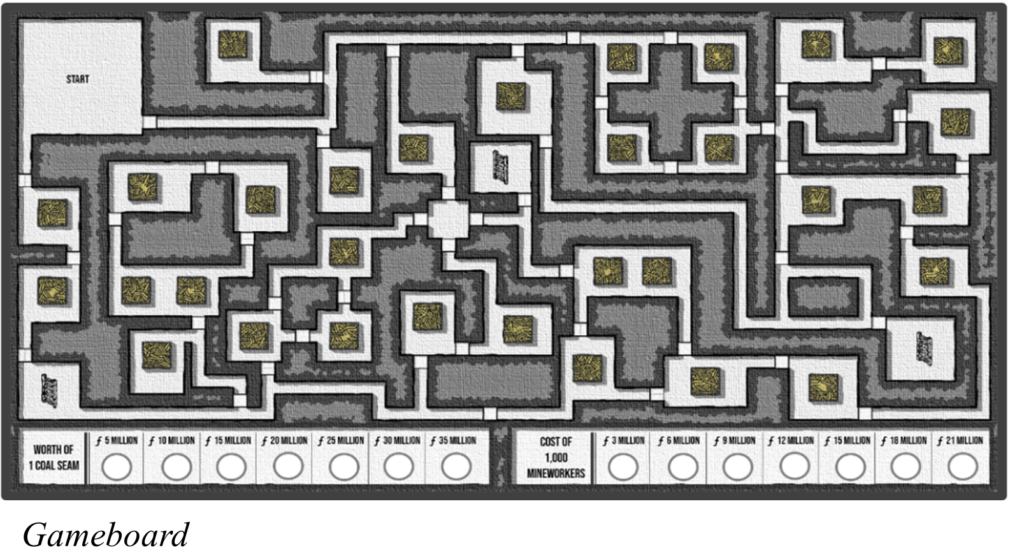
- All white spaces are blocked by red square markers (blockades)
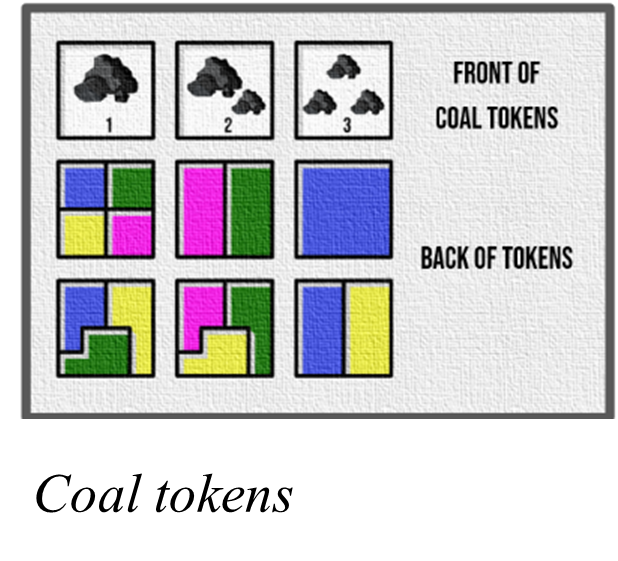
- Coal tokens (see image) are placed face down on the gold squares (back visible)
- Player setup:
- Each player selects a colour and places:
- A pawn on the gameboard at the start
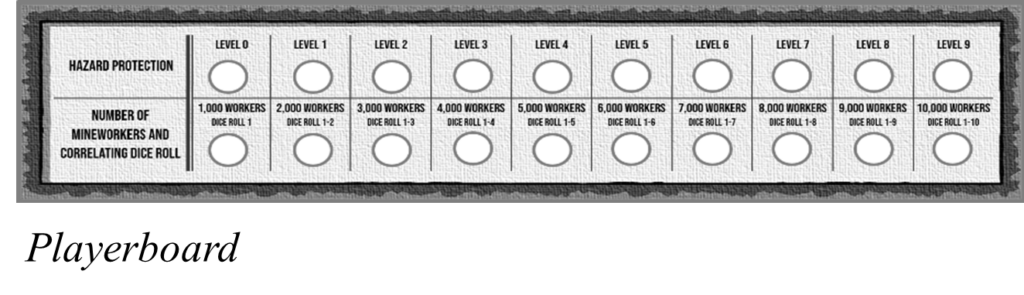
- A marker at 1,000 mineworkers at their own playerboard
- A marker at hazard protection level 0 at their own playerboard
- Players receive $50 million banknotes
- Players receive markers with the number 1, and empty markers to claim blockades
- Each player selects a colour and places:
- Initial values:
- The price for a coal seam is set at $20 million per unit
- The price for mineworkers is set at $12 million per 1,000 mineworkers
Steps each turn:
- Income: player receives $2 million
- Purchases (optional):
- Buy mineworkers (cost depends on the scale)
- Increase hazard protection for events ($3 million per level)
- Movement of pawn (if an attempt to cross blockade fails players are allowed to try again multiple times, in total players can max cross 2 blockades per turn):
- Crossing an unclaimed (red) border:
- Roll the 10-sided die ($2 million to the bank)
- If the roll matches a number within the range of your mineworkers owned, remove the red blockade and place your marker with a 1
- Crossing a claimed border:
- Roll the 10-sided die ($3 million to the player who claimed blockade first)
- If the result of your roll matches a number within the range of your mineworkers owned, you may cross the border and place your marker without a number next to the markers of the previous players who crossed this border
- Crossing your own border (that already has your marker):
- Free movement
- Moving from ladder to ladder:
- If you reach a ladder you are free to jump to any other ladder on the gameboard
- Crossing an unclaimed (red) border:
- Coal extraction
- If you reaches a new coal seam which has your colour on the back, you have to flip the coal token, and immediately exchange it for money at its current value (you cannot save coal token to trade later), and remove the token from the board. If the your colour is not on the back, you cannot claim that particular coal seam.
- Event card: At the end of each player’s turn they have to draw a card from the events deck, including events like:
- 1959: Natural gas in Groningen has been discovered and coal has become significantly worth less. Move the coal scale down 3 positions.
- 1907: The ANMB (General Dutch Mineworker Union) has been established, driving up the wages. Move the mineworker’s scale up 1 position.
- 1928: A methane explosion at the Hendrik Mine caused several deaths. All players with a hazard protection of 4 or lower have to move their number of workers 2 positions down.
End game
If all coal seams have been discovered the game ends. All players count their money: the player with the most money at the end wins.
Notes
The game is a prototype, and adjustments to numbers like pricing may be needed for smoother gameplay. The final gameboard should have larger spaces for easier pawn movement and marker placement. Also, a future version could include a modular board with tiles, adding diversity and unpredictability by letting players design a new board each game.