Zooniverse is the largest platform in the world for enabling people-powered research. It facilitates the connection between researchers and volunteers interested in participating in crowd-sourcing projects. This collaboration results in new discoveries, policy impacts, and research implications (Zooniverse, n.d. -a). In this article, I will discuss my experience using Zooniverse as a volunteer.
The process
To gain a better understanding of Zooniverse, I chose two social science projects, as they relate to my sociology minor. In Maturity of Baby Sounds, which explores how infants’ speech develops, I categorised audio clips based on the speaker’s estimated age and type of speech. (Zooniverse, n.d.-b) In Nature SPAM Filter, which analyses news coverage of wildlife, I identified headlines that specifically focus on wildlife. (Zooniverse, n.d.-c)
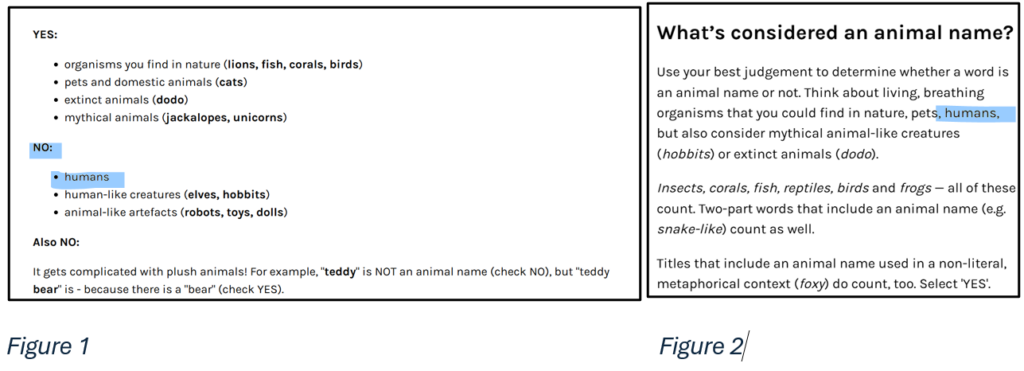
Before starting, I read the background materials and tutorial, which helped me understand project goals and how to complete the tasks. This was especially helpful for Nature SPAM Filter, where some instructions were unclear. For instance, the Need Help section and the tutorial conflicted on whether to include headlines mentioning humans (Figures 1 & 2). The background materials clarified that the goal of the project is to analyse articles about wildlife and nature, filtering out those about humans. Understanding the project goals helped me to complete both tasks more effectively.
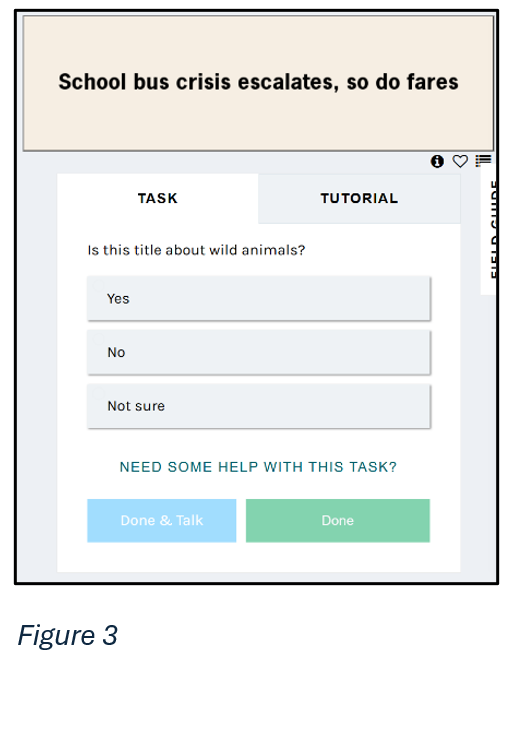
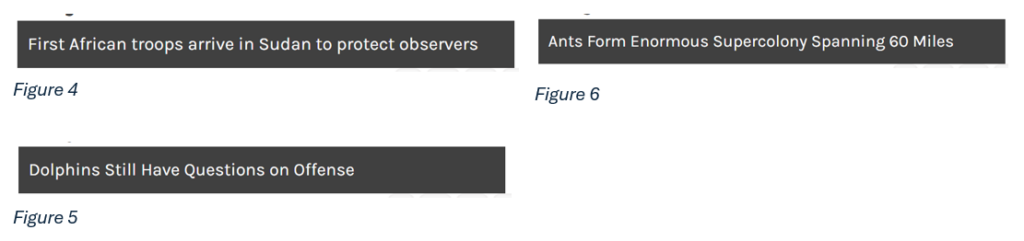
For ‘Nature Filter SPAM’ I categorized each headline by determining whether it contained an animal name: yes, no, or not sure. (Figure 3) Most headlines were unrelated to wildlife (Figure 4), some mentioned animal names but were not about wildlife (Figure 5), and only very few were relevant (Figure 6). The task was straightforward, although a clearer tutorial with examples would help.
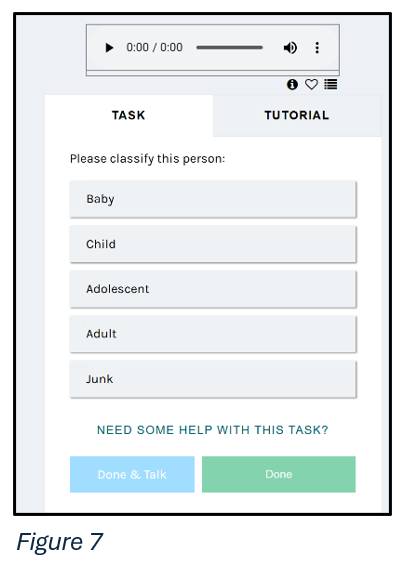
In Maturity of Baby Sounds, the task was to categorize audio clips as baby, child, adolescent, adult, or junk (Figure 5). Then I classified all sounds as laughing, crying, canonical, or non-canonical, and for adolescents or adults, I also identified the speaker’s gender. While a lot of clips were quite easy to identify, like the baby crying (Audio 1), and obvious junk (Audio 2), there were also several tricky audios (Audio 3). It was often quite challenging to identify such short clips of audio. However, this cannot be changed as it is necessary to keep the privacy of the participants.
Audio 1
Audio 2
Audio 3
Both projects were engaging and set up well. The Talk page discussions were helpful clarification when needed, ensuring accurate completion of the tasks.
Implications of Your Contribution
The contributions I made to these two crowdsourcing projects show the impact of such work on both academic research and broader society.
The Nature SPAM Filter uses news articles from around the world, which are highly accessible due to the modern internet, to analyse how people perceive wildlife. However, many keywords, such as Puma Sports, can misleadingly suggest an article is about wildlife. The Nature SPAM Filter aims to compare machine learning models to human categorisation to develop a more advanced tool for identifying news articles about wildlife.
Participants contribute to creating a dataset with ground truth data. This dataset serves as a reference to which the accuracy of different language models is compared. (Figure 8) By increasing the accuracy of these language models and filtering out irrelevant content, researchers can better analyse news articles about wildlife and find out what motivates people to care for and protect wildlife. This knowledge can be used to make a difference in how to approach the conversation around conservation of wildlife.

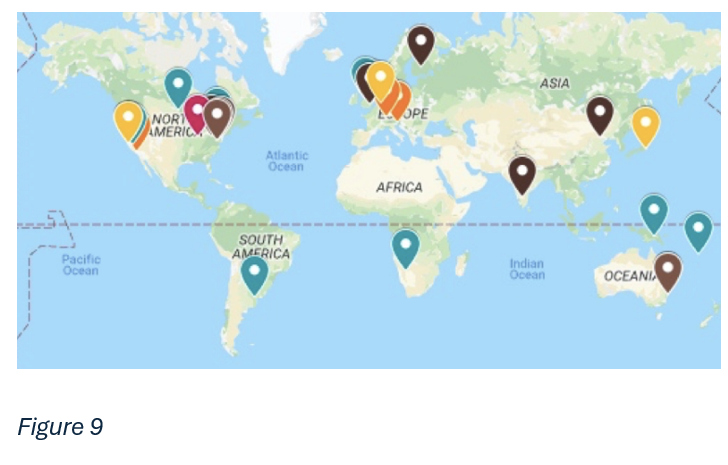
The Maturity of Baby Sounds project researches babies’ speech development, as currently, scientists know very little about this, and the only data of babies sounds that is currently present is from typically developing babies in the United States. This project tries to involve data on babies’ speech with risk of language impairment, and languages and cultures from all over the world (Figure 9), to analyse the development of speech in more detail.
In the first part of the project, researchers discovered that speech development follows a similar pattern across languages and cultures. They also discovered that children at risk of language impairment show different patterns, which could help to identify intervention points. In the second phase, to which I contributed, researchers want to analyse how the frequency and type of speech children hear from their surroundings influence their speech development. This research could help answer key questions, such as when children start producing complex sounds like adults, whether this varies by language, and how children at risk for language impairments may differ in their speech patterns. The project also explores the effectiveness of different software in identifying both adult and child speech.
Crowdsourcing has many advantages, as discussed by Melissa Terras in the article ‘Crowdsourcing in the Digital Humanities’. (Terras, 2016) Not only does it allow institutions to achieve certain goals faster, and allow academics with fewer resources to conduct research, but it also provides new ways that data can be gathered. Beyond these practical benefits, crowdsourcing projects foster broader engagement by making academic research accessible to the public, rather than limiting it to scholars. Involving interested participants fosters a wider community of people concerned with humanistic projects. This results in a stronger connection between academia and society and also democratizes knowledge by making involvement possible for non-experts as well. All together growing a community around projects helps to preserve the cultural heritage and knowledge by keeping the conversation alive.
For both projects I worked on, this is the case. Without crowdsourcing, I likely would have never encountered these specific academic research areas. Engaging with these projects gave me a stronger appreciation for the research, an increased interest in the content, and an understanding of the challenges faced by researchers. This shows how crowdsourcing not only contributes to academic findings but also involves society and encourages public participation.
What You Learned
Participating in Zooniverse projects gave me valuable insights into crowdsourced research, as well as gaining practical skills in data categorization. With taking part in the Nature SPAM Filter and Maturity of Baby Sounds projects, I improved my ability to work with data, as I had to assess both textual and auditory data systematically.
One key takeaway from the Nature SPAM Filter project is understanding the critical role of human intervention in the machine learning process. While AI-driven models are rapidly advancing, there are still many challenges that need human evaluation, especially in areas where nuance and cultural knowledge are necessary. For instance, differentiating between Puma Sports and actual wildlife references illustrates how machines still struggle to understand context.
The Maturity of Baby Sounds project taught me two main lessons. It has shown me the complexity of analysing speech, especially as they could only use very short clips of audio to protect the participants’ privacy. This restriction not only makes the categorization difficult but also limits the research, as full words and sentences cannot be analysed. Additionally, the projects’ focus on gathering data from different languages, cultures, and both typically and non-typically developing babies underscored the importance of inclusive data collection in social science studies. I feel like this is an often overlooked issue in research, where generalizations are made based on studies on a specific group of participants.
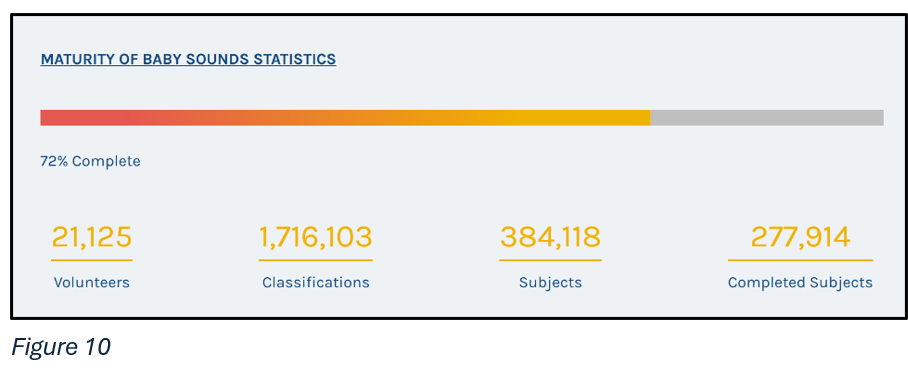
Beyond direct takeaways from the projects, participating in these projects also deepened my appreciation for the power of crowdsourcing in academic research. As Melissa Terras discusses, volunteer contributions accelerate data collection while making research more accessible to the public. For instance, Maturity of Baby Sounds has already categorized 277 thousand subjects toward their goal of 384 thousand, with the help of over 21 thousand volunteers. This level of categorization would have been impossible for the researchers to achieve on their own. (Figure 10)
Furthermore, I learned about the broader implications of crowdsourcing, including the benefits of involving society in academic research and increasing public engagement, as discussed in the Implication of Your Contribution. However, ethical concerns in crowdsourcing have also became clear. Melissa Terras raises several issues in crowdsourcing projects, such as the long-term storage of data to ensure sustainability and the question of who ‘owns’ volunteer-produced data. Also, one of the most significant issues is ensuring that volunteers are not exploited for their labour. In the past, this has for example happened with Amazon’s Mechanical Turk projects, in which people from developing countries were provided extremely low compensation for crowdsourcing tasks. (Terras, 2016)
Nathaniel Deines and his colleagues discuss, among other things, how they ensured fair labour from volunteers for the Getty’s crowdsourcing project in ‘Six Lessons from Our First Crowdsourcing Project in the Digital Humanities.’ During this project they prioritized volunteer engagement, by fostering a sense of community, providing meaningful work, and acknowledging contributions. They valued volunteers beyond the direct labour, and were encouraging and grateful for active participation and discussions. This approach highlights that it is possible to balance efficiency with fairness and accountability in crowdsourcing research. (Deines, 2017)
In the end, my engagement with Zooniverse and crowdsourcing, both provided hands-on experience and expanded my understanding of its role in academic research. It has also increased my awareness of the ethical and practical considerations involved in such projects.
Application to Your Own Work
Participating in crowdsourcing projects has inspired me to see the potential of using such initiatives in various ways. It has demonstrated that crowdsourcing enables researchers to analyse vast amounts of data that they would be unable to process alone or with the help of computers. A field that I am particularly interested in and where crowdsourcing could be very valuable is international relations and politics. The ability to gather large-scale data from a diverse range of sources can enhance the quality and depth of political research. With increasing complexity of global issues, crowdsourcing provides an effective method for analysing political trends, public opinion, and international relations.
A valuable big data source to analyse in this field is the media. In the past crowdsourcing has been used in different ways, for example to fact-checking fake news. While potential biases among participants are a risk, research has shown that the ‘wisdom of the crowd’ is actually just as accurate as professional fact-checkers. (Dizikes, 2021)
Many projects in this field could use crowdsourcing to analyse the media in fascinating ways. One example would be a project focused on analysing the difference in language used by various political streams, where crowdsourcing could help categorize the media into different streams. Another idea could involve using new articles to analyse how specific international issues, like a war, are portrayed by different countries. In such a project, translation crowdsourcing would be beneficial, as automatic translations regularly fail to capture nuanced meanings of news.
Another form of crowdsourcing, entirely different from platforms like Zooniverse, is ideation, where volunteers propose solutions to specific problems. This concept could also be applied to politics, especially policy making.
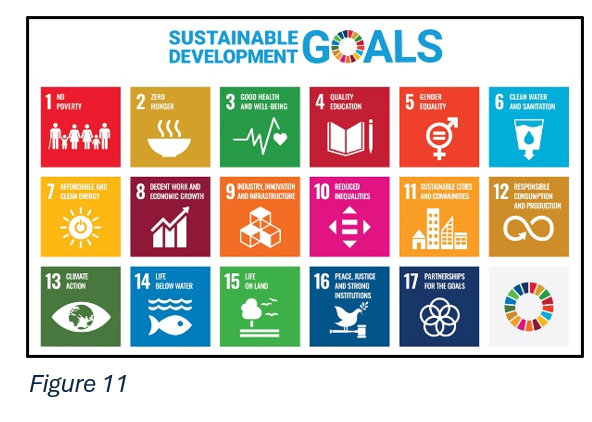
Two large-scale examples of this include Iceland’s crowdsourced constitution, where all citizens could engage, propose ideas, and vote on their new constitution (Kinna, 2016), and the Sustainable Development Goals, where people could vote in 2012 which issues should become the final goals (Figure 11) (MYWorld2030, n.d.).
Although conducting such large crowdsourcing projects is out of my reach in the near future, a similar approach could be used on a smaller scale to gather public opinions and ideas to provide advice for a specific local issue. I think it is important to remember that crowdsourcing for ideas is a good idea to involve people and generate ideas to create good policies.
Building a broader community of people interested in international political research is also effective for increasing public involvement in politics. Since political decisions impact everyone’s lives, fostering active engagement with political topics can make the field more accessible and relevant. Crowdsourcing, whether for data analysis or idea generation, has the potential to bridge the gap between academic research and public discourse, encouraging more people to participate in shaping policies and understanding global affairs.
Conclusion
Overall, participating in projects on Zooniverse has deepened my understanding of crowdsourcing and its potential. The ability to contribute meaningfully to large-scale projects while gaining practical skills shows the value of citizen science. Crowdsourcing not only accelerates research but also improves the relation between researchers and the public. Looking ahead, I would be interested in using crowdsourcing in fields like international relations and politics, to conduct data analysis, improve the creation of policies, and get society involved.
References
- Deines, N (Feb 7, 2017). Six Lessons from Our First Crowdsourcing Project in the Digital Humanities. [Getty News] Available at: https://www.getty.edu/news/six-lessons-learned-from-our-first-crowdsourcing-project-in-the-digital-humanities/
- Dizikes, P (Sep 1, 2021) Study: Crowds can wise up to fake news. [MIT News] Available at: https://news.mit.edu/2021/crowd-source-fact-checking-0901
- Kinna, R et all. (Oct 28, 2016) Iceland’s crowd-sourced constitution: hope for disillusioned voters everywhere. [The Guardian] Available at: https://theconversation.com/icelands-crowd-sourced-constitution-hope-for-disillusioned-voters-everywhere-67803
- M, Terras. (2016) Crowdsourcing in Digital Humanities. A New Companion to Digital Humanities Available at: https://discovery.ucl.ac.uk/id/eprint/1447269/1/MTerras_Crowdsourcing%20in%20Digital%20Humanities_Final.pdf
- MYWorld2030, n.d. About. [online] Available at: https://about.myworld2030.org/about-new/
- Zooniverse (n.d.-a) About. [online] Available at: https://www.zooniverse.org/about
- Zooniverse (n.d.-b) Maturity of Baby Sounds. [online] Available at: https://www.zooniverse.org/projects/laac-lscp/maturity-of-baby-sounds
- Zooniverse (n.d.-c) Nature SPAM Filter. [online] Available at: https://www.zooniverse.org/projects/dverissimo/nature-spam-filter